 sklep@ccy.pl
 +48 514 563 619


Adapter Tesla 26 pin - model 3 - 2019+
5.jpg)
GTIN: 5908258866957
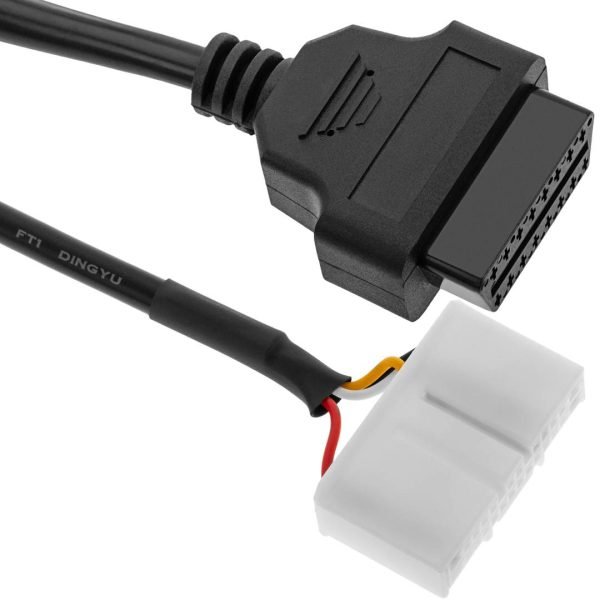
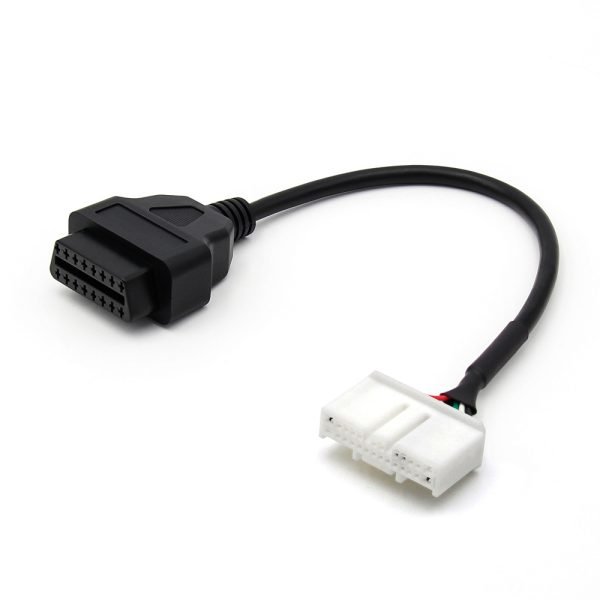
This OBDII 26-pin adapter has been specifically designed for the Tesla Model 3. It allows you to connect an OBD2 diagnostic interface to the socket in the car.
Practical applications:
This cable-adapter works with OBD2 scanners and OBDII code readers (USB/WiFi/Bluetooth), enabling full diagnostics, including reading battery pack temperature, engine temperature, cell voltage, and other parameters not available on the vehicle's main screen.
Supported models: This 26-pin OBD2 adapter is compatible with the Tesla Model 3 produced from 2019 onwards. Unfortunately, it does not work with Model 3 produced before 2019.
Hardware and software compatibility: The cable works with applications such as “Scan My Tesla” and with OBD2 scanners and OBDII code readers (USB/WiFi/Bluetooth), including OBDLink LX/MX+, Vlinker MC, and others.
Quality of the cable: This is a high-quality, durable cable.
Depending on the vehicle's software, communication interface, and monitoring application, additional information may be available regarding charging power and current, energy flow, estimated battery state or capacity, and logs of driving or charging data.
These are examples of application-dependent data, not guaranteed features of the cable. Readings, available signals, and their presentation may vary between vehicle versions and application releases.
Additional compatibility information
The shape of the connector, its mechanical coding, pin configuration, and vehicle wiring must be compatible with this adapter. The production year alone is not sufficient to confirm compatibility.
Model 3 Highland (facelift version introduced at the end of 2023): the connection method should be verified individually before ordering. Compatibility with this older 26-pin adapter is not guaranteed.
The product should also be distinguished from adapters labeled as Tesla 26+26 PIN. These two products are not automatically interchangeable. For this specific cable, compatibility with Model S, Model X, or Model Y is not declared.
Reader and application requirements
The presence of an OBD2 connector in the adapter does not mean that the vehicle is equivalent to a traditional combustion engine car in terms of standard OBD2 diagnostics. The reader must support the required CAN communication, and the application must recognize the data available in the specific version of the Tesla vehicle.
Not every universal ELM327 reader or standard fault code reading application can decode Tesla-specific data. Compatibility should be checked based on the information about supported devices provided by the application developer. The adapter itself does not require software installation; drivers or permissions may be required by the chosen scanner and operating system.
The adapter does not provide access to all vehicle drivers, does not guarantee programming or clearing of fault codes, and does not replace Tesla Toolbox or manufacturer service procedures.
Package contents
- 1 × diagnostic cable-adapter Tesla Model 3 26-pin → OBD2 16-pin.
Reviews
Delivery - cost and time
Orders weighing less than 2 kg are shipped via Polish Post Office. Once outside the borders of Poland, the package will be handled by a local company providing standard postal services.
Orders heavier than 2 kg are sent via courier service. The choice of courier company is tailored to each order and generally based on the lowest available price.
Price of international delivery :
Up to 2 kg - 39PLNMore than 2 kg - individual calculation
How to make an order
FIRST:
Order by email. Let me know what do you need. PRESS HERESECOND:
Order by our website or by EBAY.THIRD:
Only for companies and industries. Are you reseller? Let me know - we can offer very good prices. PRESS HERENewest products in the store


 CCYinterfaces
 CCYinterfejsy
5.jpg)